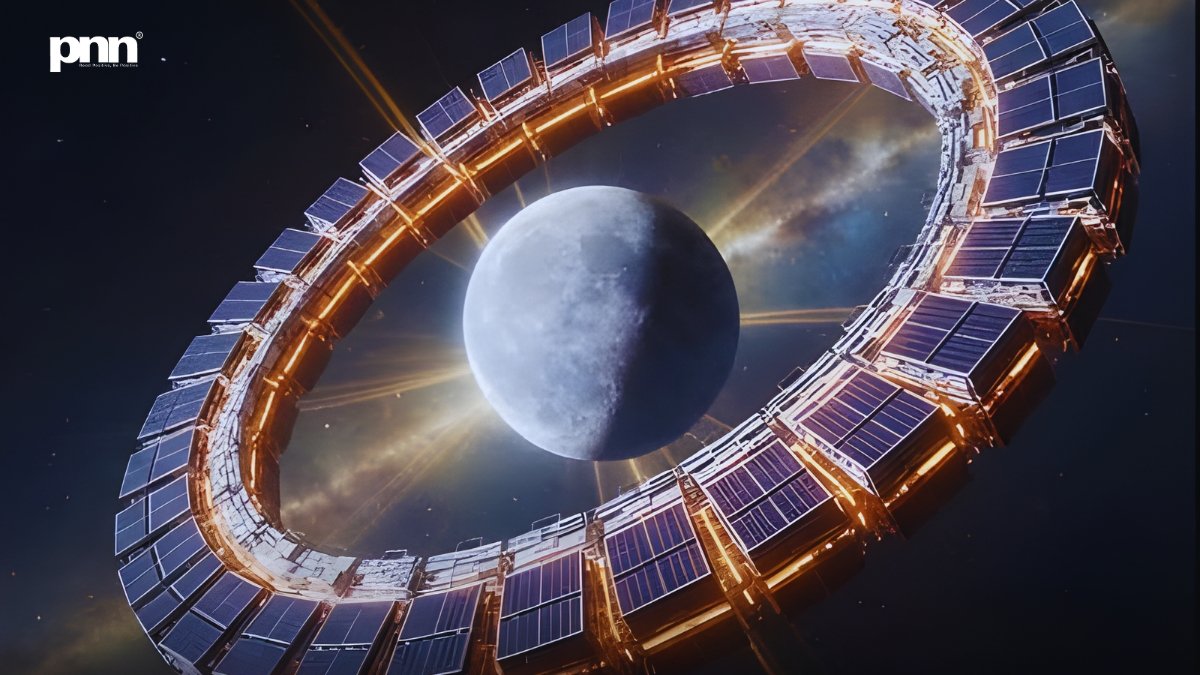
New Delhi [India], February 09: The phrase “lunar ring” sounds like something a marketing department would invent after a late lunch, but the geometry is embarrassingly straightforward. The Moon is tidally locked, its equator running in a patient circle of dust and rock that hasn’t felt wind in four billion years. Put solar panels along that belt and, because of the Moon’s slow, stately rotation, some part of that belt will almost always be in sunlight. Not all of it. Not cleanly. But enough. The idea is to turn that accident of celestial mechanics into a power plant.
Japan calls it the Lunar Ring. Eleven thousand kilometres of photovoltaic skin wrapped around the Moon like an industrial bracelet. A permanent line of collectors harvesting the Sun’s energy and throwing it back toward Earth in the form of microwaves or lasers. It is an engineer’s dream because it reduces the Moon to a predictable surface and the Sun to a dependable source of energy. No clouds. No seasons in the terrestrial sense. Just a slow, obedient orbit and a long, clean day.
The day on the Moon lasts about two Earth weeks. The night lasts the same. Anyone who has spent more than five minutes thinking about solar power on the lunar surface arrives at the same unpleasant fact: your panels sit in darkness for half a month unless you move them or place them somewhere the Sun never really leaves. The poles offer that trick—peaks of eternal light, the phrase people like to use—but they are small, crowded, and inconveniently shaped. You can’t build a global energy economy on a handful of ridges.
So the ring solves it by brute force. If one segment falls into darkness, another segment further along the equator will be lit. Power flows around the loop, from bright side to dark side, like current through a wire. It’s not elegant. It’s not even subtle. It’s just very, very large.
And that’s where the numbers start to feel less like engineering and more like stubbornness. Eleven thousand kilometres is not a poetic figure. It’s roughly the circumference of the Moon at the equator. The proposal is not for a cluster of stations or a chain of outposts. It is a continuous industrial band encircling another world. Imagine building a solar farm that wraps around the Earth’s equator, crossing oceans, jungles, deserts, and cities, then imagine doing it in a vacuum, at minus 170 degrees Celsius, with abrasive dust that behaves like ground glass.
The dust is the real antagonist here. Lunar regolith is electrostatically charged, jagged, and chemically eager. It sticks to everything. Apollo astronauts complained about it constantly; it ate through seals, scratched visors, and clogged joints. Now picture conveyor belts, robotic installers, transmission lines, microwave emitters—all of them operating in that environment for decades. You can design around it. Engineers always say that. But the Moon doesn’t negotiate. It simply continues being the Moon.
There is also the matter of getting there. Every kilogram of hardware must be launched out of Earth’s gravity well, ferried across cislunar space, and then lowered gently onto the surface. Even with reusable rockets, even with optimistic cost curves, the arithmetic is not friendly. Tens of thousands of tonnes of equipment, probably more. Panels, support structures, wiring, control systems, transmitters. Then the robots assemble them. Then the spare parts for the robots.
People talk about using lunar materials—mining regolith, refining it into silicon, and printing panels on-site. That is the kind of sentence that appears in concept papers because it closes a budget gap. In practice, it means building an entire mining and manufacturing industry on the Moon before you even start building the power system. The ring is not just a power project. It is an industrial civilization, scaled down and transplanted into a vacuum.
Transmission back to Earth is the quieter complication. The ring’s power is useless unless it can be delivered. The current favourite is microwave beaming: convert the electricity into microwaves, aim them at giant receiving stations—rectennas—on Earth, and convert them back into electricity. It works in principle. Experiments have been done over small distances. But the beam must remain tightly controlled across hundreds of thousands of kilometres. Any serious drift and you’re heating the wrong patch of atmosphere.
Safety committees would have opinions about that. So would farmers whose fields suddenly host multi-kilometre rectennas. The ring shifts the geography of energy: power doesn’t come from a river or a coal seam anymore. It comes from a spot in the sky, aimed deliberately at a patch of land chosen for its emptiness and political convenience. The infrastructure becomes less local, more orbital, and far less negotiable.
But the physics itself is not controversial. The Sun delivers more energy to the Moon than humanity uses in a year. The Moon has no weather to interrupt collection. Orbital mechanics make the equatorial belt a logical place to smooth out the light–dark cycle. None of this is speculative. It’s arithmetic and geometry.
The difficulty is everything that comes after the arithmetic.
A structure that long cannot be built in one heroic push. It must grow, segment by segment, over decades. Which means generations of engineers working on the same line of panels, adding to a belt that will outlive their careers. Maintenance crews—robotic or human—circling the Moon forever, replacing worn emitters, cleaning dust, patching micrometeorite damage. The ring is not a project; it is a permanent obligation.
There’s a certain honesty in that. Earth’s energy systems are also permanent obligations, just messier ones. Coal plants, gas pipelines, offshore rigs—they all require constant tending. The lunar ring merely relocates the maintenance problem a quarter of a million miles away and dresses it in vacuum and silence.
Japan’s involvement makes sense if you look at it from their side. An island nation, energy-poor, dependent on imports, shaken by nuclear accidents and fossil price shocks. The idea of pulling clean power directly from the Sun, bypassing fuel markets and shipping lanes, has an obvious appeal. If you can’t find resources under your soil, you start looking upward.
Still, the ring is not a quick fix. It is a century-scale object. By the time the full belt exists—if it ever does—the political systems that conceived it will have changed beyond recognition. The engineers know this. They draw the diagrams anyway.
Because in the end, the Moon is just sitting there, circling us with maddening regularity, bathing half its surface in sunlight at any given moment. The energy is free, constant, and utterly indifferent. The only real question is how much machinery we are willing to scatter across another world to catch it. And how long we’re prepared to keep that machinery alive once it’s there.